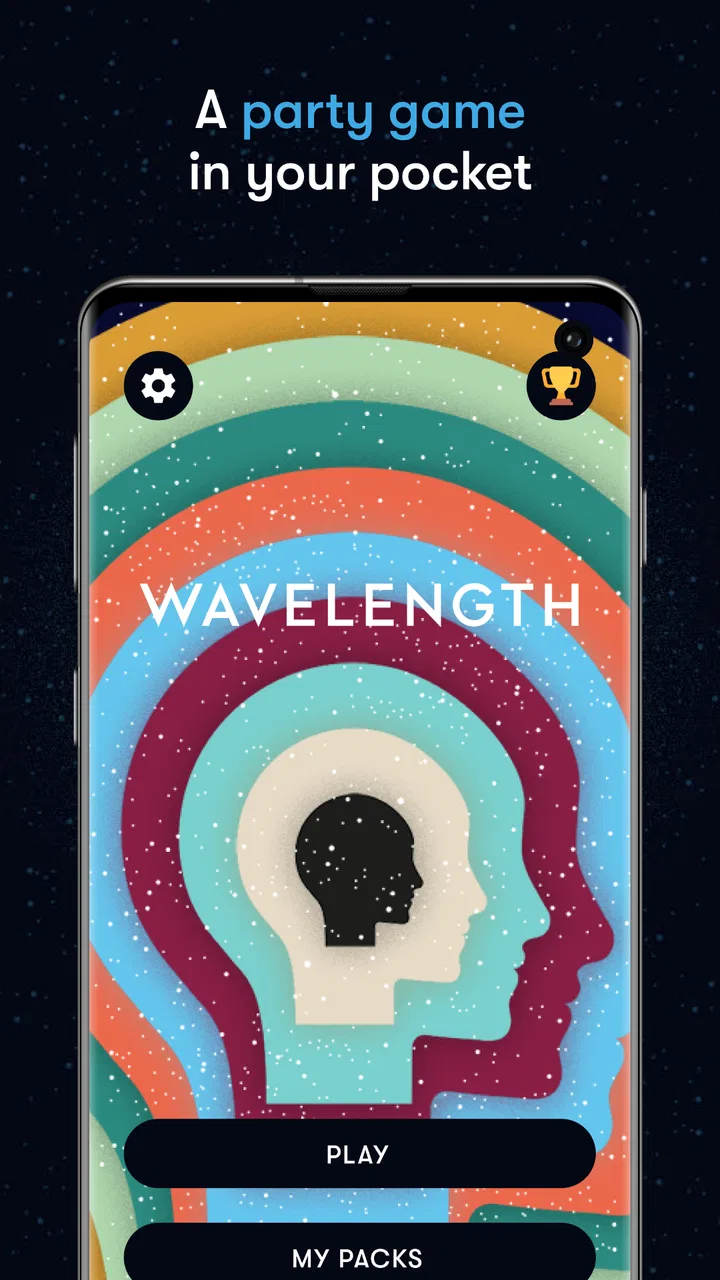
Wavelength
- 4.8
- Rating
- 1.00M
- Installs
- Free
- Price

 Analysis by App-foxy
I found Wavelength most interesting when I stopped treating it like a conventional word puzzle and used it as a group game. CMYK Games presents it as a mind-reading party game, and that description fits the experience better than calling it a solo vocabulary challenge. The fun comes from trying to predict how another person interprets a clue, then discovering whether your shared understanding was actually as close as you thought.
That makes it a particularly good fit for a living room, a casual gathering, or a quick session with friends who enjoy discussing answers rather than silently chasing a high score. I also appreciate that it is free to start and suitable for Everyone, so it is easy to suggest without asking the group to commit money first. The trade-off is that the game depends heavily on the people around you. With the right group, it creates lively arguments and surprising guesses; with a distracted or very small group, it can feel less satisfying than a traditional word game.
Getting a group ready without unnecessary friction
The first place I would expect people to get stuck is not the wordplay itself but the social setup. Wavelength works best when everyone understands that the goal is not simply to produce the cleverest answer. Players need to think about the same idea from different angles, listen to the reasoning behind a guess, and accept that a clue can be technically defensible while still missing the group’s intended interpretation.
You May Also Like

 Blood Strike: 2.5 Anniversary
Blood Strike’s Loadouts Turn Every Drop Into a Tactical Gamble
A close look at Blood Strike’s custom loadouts: how fast access to signature weapons reshapes its battle royale rhythm, rewards preparation, and narrows the gap between fights.

 Pandora - Music & Podcasts
Pandora’s Music Is Easy to Start, but Harder to Recover
Pandora’s strength is its low-effort path from a seed to a station. Its weak spot is how much confidence it asks you to place in connection, setup, and quiet recovery.

 8 Ball Pool
 Is Built on Rivalries, Rematches, and Routine
A close look at the rivalries, rematches, shared routines, and unanswered safety questions that turn a quick pool match into a persistent mobile community.

 Samsung Music
’s Quiet Strength Is Playing What You Already Own
Its reach comes less from spectacle than from dependable access to a personal library. That simplicity is both the app’s strongest retention engine and its ceiling.

 AccuWeather: Weather Radar
AccuWeather Review: A Quick, Clear Forecast for Everyday Decisions
For everyday plans, the best forecast is the one you can understand quickly. AccuWeather makes rain timing, radar, and local conditions easy to act on, with a few trade-offs.

 Hill Climb Racing
Why Hill Climb Racing Still Turns Crashes Into One More Run
A tiny car, a bumpy hill and one more upgrade: Hill Climb Racing keeps resurfacing because its simple chaos makes every near-miss feel personal.
More From Our News Desk



Before beginning, I would make sure everyone knows who is playing, who is currently giving the clue, and who is making the guess. That sounds obvious, but party games become awkward when several people start answering at once. A short explanation of the turn flow also helps: one person should have time to form a clue, the others should make their prediction, and the group should discuss the result afterward rather than interrupting the turn with competing suggestions.
On Android, the game supports devices running Android 6.0 or later. The current version is 1.5.3, and checking those two details before a gathering is a sensible first step if the app will be installed on an older phone or tablet. I would also install it before guests arrive rather than making the first launch part of the party. That gives you time to open the game, confirm that it starts normally, and become familiar with the basic controls.
The same preparation matters on iOS, even though the practical checks may look different. Keep the device charged, close unrelated apps if the phone is older, and decide which screen will be passed around or shown to the group. A party game can lose momentum quickly when players are waiting for someone to find the correct device, rotate the screen, or finish a system prompt.
One useful habit is to choose a consistent place for the phone between turns. If it is passed from person to person without a clear routine, someone may accidentally reveal information too early or skip the moment when the group should be making its prediction. I found that a simple “clue first, guesses second, reveal and discuss last” rhythm makes the session feel much smoother than relying on everyone to improvise.
The game’s strong average rating of 4.8, based on around 21 thousand ratings, suggests that its central idea connects with a broad audience. Its reach is also substantial, with over a million installs. I would not read those figures as a guarantee that every group will enjoy every round, though. The appeal is very dependent on conversation, and that means the personalities in the room matter almost as much as the game itself.
What to check before blaming the app
If the game does not behave as expected, I would begin with ordinary device checks rather than assuming the problem is a broken game mechanic. Confirm that the installation completed, reopen the app, and make sure the device has enough free storage for normal operation. If the screen appears frozen, wait briefly before tapping repeatedly; rapid repeated touches can make it harder to tell whether the app is responding.
A restart is also worth trying when the game launches but a screen does not advance. On a shared party device, background apps, temporary system congestion, or a nearly full storage area can create problems that look specific to Wavelength. Closing the game completely and opening it again is a low-effort way to separate a temporary hiccup from a repeatable issue.
Because the game is free, it is easy to download during a gathering, but that is not the best workflow. A weak connection can make installation or updates take longer, and a group waiting around for a download is already losing the energy that makes this type of game work. I would prepare the app in advance, especially if the event is taking place somewhere with unreliable mobile service.
The game includes optional in-app purchases priced from $0.99 to $9.99 per item. I would treat those as a separate decision from whether the basic game suits your group. Start with the free experience, see whether people actually enjoy the clue-and-guess rhythm, and only then consider spending money. That avoids paying for extras before you know whether the social format matches your friends.
It is also worth setting expectations around the age label. Wavelength is rated Everyone, which makes it approachable for mixed-age groups, but a content rating does not automatically solve every social difference. Younger players may interpret a prompt differently from adults, and that can be part of the fun, although a group may need to explain unfamiliar references or give someone more time to form a clue.
Recovering a round when the group loses the thread
One of the most useful recovery techniques is to separate disagreement about the clue from disagreement about the target. If a guess seems strange, ask the player to explain what they associated with the clue before deciding whether it was reasonable. This turns a confusing turn into the actual conversation the game is built around. It also prevents the loudest person in the room from immediately declaring an answer wrong without hearing the intended logic.
If people are talking over one another, pause and nominate one person to give the clue and one person to speak for the guessing side. Everyone else can contribute ideas, but the group should have a clear final guess. This small change keeps the game from becoming a shouting contest and gives quieter players a better chance to influence the result.
Another practical adjustment is to shorten the discussion after a particularly ambiguous clue. Not every turn needs a long debate. If the group has already understood why the clue produced different interpretations, reveal the result and move on. Wavelength is strongest when the conversation feels spontaneous; overanalyzing every answer can make it feel like a formal examination.
When a player cannot think of a clue, I would encourage them to describe a familiar contrast rather than search for a perfect phrase. Everyday comparisons are often more useful than elaborate wordplay because the other players can place themselves somewhere along the same mental scale. The best clue is not necessarily the most original one. It is the one that gives the group a reasonable chance to reconstruct the clue-giver’s thinking.
A less obvious tip is to pay attention to the group’s shared vocabulary over several turns. If everyone has already established that a certain reference means something very specific to them, later clues can become more precise. On the other hand, if a reference caused confusion earlier, avoid building another turn around it. The game rewards noticing how your particular group thinks, not just knowing a large number of words.
If someone accidentally sees information intended to remain hidden, do not spend several minutes trying to preserve a compromised turn. A fair recovery is to restart that turn with a new clue or simply treat it as a practice round. The important thing is to keep the mood relaxed. Party games are more enjoyable when the group values momentum and laughter over perfect record keeping.
When the problem is the situation, not Wavelength
Some disappointing sessions are caused by the setting rather than the game. A noisy restaurant, a crowded room, or a gathering where people are constantly checking messages makes the central mind-reading idea much harder to enjoy. Players need to hear clues, remember the exact wording, and give each other enough attention to explain an interpretation.
The game may also be a poor choice when your group wants a quiet, individual activity. If everyone prefers to solve something privately, a classic crossword, a solo word puzzle, or another turn-based game with less discussion may be a better match. Wavelength asks players to expose their reasoning, and that can feel uncomfortable for people who dislike being judged on an unusual association.
It is not ideal for every large gathering either. With too many people trying to contribute at once, the discussion can become unfocused. In that situation, I would divide the gathering into smaller groups or use a rotating spokesperson. That preserves the social element without forcing every player to compete for the same moment of attention.
There is also a difference between a group that enjoys friendly disagreement and one that treats every answer as a contest. Wavelength can reveal how differently people interpret the same idea, which is entertaining when everyone is comfortable with ambiguity. It becomes tiring when players argue about whether a clue is objectively correct. The app cannot fix that atmosphere; the host needs to establish that explanations matter more than winning an argument.
Compared with ordinary word searches or crossword-style apps, this game offers less value as a private brain-training routine. It is not the option I would choose for a commute when I want a quiet challenge that progresses at my own pace. Compared with a traditional party quiz, however, it has a more personal kind of tension: the question is not only whether you know an answer, but whether you understand how another player ranks or frames an idea.
That distinction is the reason I would recommend it to friends who have already grown tired of trivia formats. A trivia game rewards stored knowledge, while Wavelength rewards empathy, communication, and awareness of another person’s mental shortcuts. Neither approach is universally better. The right choice depends on whether your group wants to demonstrate what it knows or discover how differently it thinks.
Small habits that make repeated sessions better
For a first session, I would avoid trying to optimize the score or rush through the available material. Let players learn how much explanation the group needs and which kinds of clues create useful discussion. Once everyone understands the rhythm, turns become quicker because players stop overexplaining the rules and start focusing on the interpretation.
Rotate the clue-giver regularly. One person may naturally think in broad categories, while another prefers concrete examples. If the same player remains in control, the group may begin adapting only to that person’s style rather than testing its ability to read different people. Rotation also prevents the experience from becoming a performance by one particularly confident player.
For remote or hybrid gatherings, I would be cautious about assuming that the app alone solves communication problems. The phone can provide the game, but the group still needs a reliable way to hear one another and decide whose turn it is. If the call has delays or people are speaking from different rooms, use shorter contributions and repeat the final guess clearly before revealing the result.
A practical household use is a short session after dinner, with the phone placed in the middle of the table and no expectation of playing for a fixed length of time. If the group is tired, a few turns can still work because each one creates its own small conversation. If everyone is enjoying it, continue. That flexibility is more useful than treating the game like a scheduled tournament.
It can also work as an icebreaker, but I would choose the group carefully. People who have just met may be cautious with their clues, and that can make early turns feel flat. A host can help by giving players permission to use ordinary, low-pressure associations rather than trying to be impressive. Once the group sees that unexpected interpretations are welcome, the conversation usually becomes more natural.
The developer, CMYK Games, has kept the core premise easy to understand, but the experience still benefits from a human host who notices when the group needs a reset. That is an important part of the review: the app provides the structure, while the quality of the session comes from how people manage the structure. If your group expects the software to carry the entire evening without conversation, this is probably not the right pick.
My practical verdict after using it
Wavelength is a thoughtful word game disguised as a party activity. I like that it makes interpretation the main event instead of treating language as a list of correct answers. The most memorable moments come when two people use the same clue but place it in completely different parts of their mental map, then realize that both viewpoints make sense.
I would recommend it to families, friend groups, and casual hosts who want a free game that can start a conversation without requiring complicated preparation. The Everyone rating makes it approachable, and the large player response, including a 4.8 average and more than a million installs, indicates that the format has found a substantial audience. Those figures are encouraging, but the real test is whether your group enjoys explaining its thought process.
I would skip it if you want a solo word challenge, a fast competitive quiz, or a game that remains equally engaging when nobody feels like talking. I would also choose a more structured alternative for a group that dislikes ambiguity or tends to argue over subjective answers. In those situations, a crossword, word search, or knowledge-based quiz gives clearer feedback and places less pressure on social interpretation.
For everyone else, my advice is simple: install it before the gathering, test the opening flow, agree on a turn routine, and keep the first session relaxed. If a round becomes confusing, ask for the clue-giver’s reasoning instead of forcing an immediate judgment. That one habit captures what makes the game worthwhile. Its real strength is not guessing a hidden answer; it is learning how the people beside you think.
As a free game from CMYK Games, Wavelength earns a place on my party-game shortlist, with the understanding that it is a social tool rather than a complete entertainment system on its own. The optional purchases are worth considering only after the basic experience has proved useful to your group. When the setting is right and the players are willing to listen, it turns a simple device into a surprisingly revealing conversation starter.
FAQs for Wavelength
01What is Wavelength and what does it do?
Wavelength is a social communication app designed to enhance group interactions through shared experiences and deep conversations. It offers a platform for connecting with friends, family, or colleagues by creating private or public groups where you can share messages, photos, and engage in interactive content. The app aims to make communication more meaningful and engaging.
02Is Wavelength available for both Android and iOS devices?
Yes, Wavelength is available for download on both Android and iOS platforms. Users can find it on the Google Play Store for Android devices and the Apple App Store for iOS devices. Ensure your device meets the necessary operating system requirements for optimal performance and a smooth user experience.
03Does Wavelength offer any privacy features for user data?
Wavelength prioritizes user privacy and offers several features to protect data. Users can create private groups, control who sees their content, and manage permissions for sharing. Additionally, all communication is encrypted, ensuring that your conversations remain secure and private. Always review the app's privacy policy for detailed information.
04Are there any in-app purchases or subscription fees involved?
Wavelength is free to download and use, but it may offer in-app purchases or subscription options for additional features or premium content. These enhancements could include advanced customization options, additional storage, or exclusive content. It’s advisable to review the app's pricing details within the app store or official website.
05What makes Wavelength different from other social communication apps?
Wavelength stands out by focusing on meaningful connections and interactive experiences. Unlike typical messaging apps, it offers unique features like themed conversations, interactive media sharing, and community-building tools. It’s designed to foster deeper engagement, making it ideal for users who value quality interactions over quantity.
Pros
- User-friendly interface simplifies communication.
- Supports multiple chat formats seamlessly.
- Strong emphasis on privacy and security.
- Integrates well with other platforms.
- Customizable notifications for better user control.
Cons
- Limited language options for global users.
- Occasional bugs in group chat features.
- High battery usage on older devices.
- Frequent updates can be intrusive.
- Some features locked behind premium access.

Wavelength
Gallery